
 JULES MASSENET
CLAUDE DEBUSSY
CAMILLE SAINT-SAËNS
ERIK SATIE
ERIK SATIE
GABRIEL FAURE
MAURICE RAVEL
CLAUDE DEBUSSY
Prologue
Serenade
Finale
CLAUDE DEBUSSY
Meditation from "Thais" arranged for cello and piano
Arabesque no.1
The Swan (Carnival of the Animals) - cello and piano
First Gymnopédie
Third Gnossienne
Elegie opus 24 - cello and piano
Ondine (Gaspard de la Nuit)
Sonata No. 1 in D Minor for Cello and Piano
Lent
Modérément animé
Animé
L'isle joyeuse
4:14
5:04
2:36
3:40
2:51
6:29
7:30
4:44
3:56
3:44
7:07
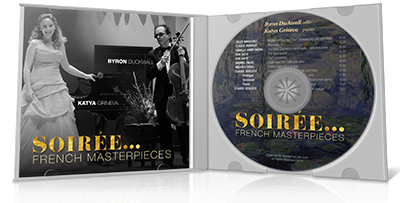
Soirée…French Masterpieces
“Last November while playing Ravel “Jeu d’Eau” at an Ashram in Northern California, the idea came to me to do a French music album. Then a series of unexpected events happened…a concert at the Trianon Theatre in San Jose, the night of the Paris attacks and a private concert for John Chambers, who spoke to President Holland that day and filmed us playing a dedication to the French people. All this inspired me to do this album.”
Katya Grineva
“When I was a child I used to listen every day to Maurice Gendron’s recording of the Saint-Saëns Cello Concerto. I was in awe of his talent. Later while playing with the San Jose Symphony, I met Pierre Fournier and developed a relationship with him. Over time my love of the French cellists has grown, especially Fournier. More than any cellist, his sensibilities resonate with me. So when Katya told me her idea to do a French album, I was intrigued.”
Byron Duckwall
about the music…
Debussy and Ravel, two French musical giants, shared the influences of Wagner, Rimsky-Korsakov and Javanese Gamelan music. Although they are often lumped together as “Impressionists,” their styles and personalities differed greatly. Ravel was fastidious in his attention to form and the development of his craft. He was a painstaking worker who developed a style of great clarity which includes elements of the baroque and neoclassicism.
Debussy, a prodigy said, “I am trying to make something new – realities, as it were: what imbeciles call Impressionism.” Ravel said of Debussy, “(his) genius was obviously one of great individuality, creating its own laws, constantly in evolution, expressing itself freely, yet always faithful to French tradition.” Debussy’s music is noted for its sensory content and frequent usage of nontraditional tonalities.
Fauré was more traditional but very influential and represents the link between German Romanticism and Impressionism. Satie, the brilliant eccentric was inspired by Gregorian chant in his popular Gymmnopédies and Gnossiennes.
To Adi Da we wish to thank for His extraordinary spiritual influence.
Copyright © MTC Recordings 2016 All Rights Reserved.

“Last November while playing Ravel “Jeu d’Eau” at an Ashram in Northern California, the idea came to me to do a French music album. Then a series of unexpected events happened…a concert at the Trianon Theatre in San Jose, the night of the Paris attacks and a private concert for John Chambers, who spoke to President Holland that day and filmed us playing a dedication to the French people. All this inspired me to do this album.”
Katya Grineva
“When I was a child I used to listen every day to Maurice Gendron’s recording of the Saint-Saëns Cello Concerto. I was in awe of his talent. Later while playing with the San Jose Symphony, I met Pierre Fournier and developed a relationship with him. Over time my love of the French cellists has grown, especially Fournier. More than any cellist, his sensibilities resonate with me. So when Katya told me her idea to do a French album, I was intrigued.”
Byron Duckwall
about the music…
Debussy and Ravel, two French musical giants, shared the influences of Wagner, Rimsky-Korsakov and Javanese Gamelan music. Although they are often lumped together as “Impressionists,” their styles and personalities differed greatly. Ravel was fastidious in his attention to form and the development of his craft. He was a painstaking worker who developed a style of great clarity which includes elements of the baroque and neoclassicism.
Debussy, a prodigy said, “I am trying to make something new – realities, as it were: what imbeciles call Impressionism.” Ravel said of Debussy, “(his) genius was obviously one of great individuality, creating its own laws, constantly in evolution, expressing itself freely, yet always faithful to French tradition.” Debussy’s music is noted for its sensory content and frequent usage of nontraditional tonalities.
Fauré was more traditional but very influential and represents the link between German Romanticism and Impressionism. Satie, the brilliant eccentric was inspired by Gregorian chant in his popular Gymmnopédies and Gnossiennes.
To Adi Da we wish to thank for His extraordinary spiritual influence.

“Last November while playing Ravel “Jeu d’Eau” at an Ashram in Northern California, the idea came to me to do a French music album. Then a series of unexpected events happened…a concert at the Trianon Theatre in San Jose, the night of the Paris attacks and a private concert for John Chambers, who spoke to President Holland that day and filmed us playing a dedication to the French people. All this inspired me to do this album.”
Katya Grineva
“When I was a child I used to listen every day to Maurice Gendron’s recording of the Saint-Saëns Cello Concerto. I was in awe of his talent. Later while playing with the San Jose Symphony, I met Pierre Fournier and developed a relationship with him. Over time my love of the French cellists has grown, especially Fournier. More than any cellist, his sensibilities resonate with me. So when Katya told me her idea to do a French album, I was intrigued.”
Byron Duckwall
about the music…
Debussy and Ravel, two French musical giants, shared the influences of Wagner, Rimsky-Korsakov and Javanese Gamelan music. Although they are often lumped together as “Impressionists,” their styles and personalities differed greatly. Ravel was fastidious in his attention to form and the development of his craft. He was a painstaking worker who developed a style of great clarity which includes elements of the baroque and neoclassicism.
Debussy, a prodigy said, “I am trying to make something new – realities, as it were: what imbeciles call Impressionism.” Ravel said of Debussy, “(his) genius was obviously one of great individuality, creating its own laws, constantly in evolution, expressing itself freely, yet always faithful to French tradition.” Debussy’s music is noted for its sensory content and frequent usage of nontraditional tonalities.
Fauré was more traditional but very influential and represents the link between German Romanticism and Impressionism. Satie, the brilliant eccentric was inspired by Gregorian chant in his popular Gymmnopédies and Gnossiennes.
To Adi Da we wish to thank for His extraordinary spiritual influence.


AUDIO SAMPLES